
5 Days Dunhuang-Jiayuguan-Zhangye Silk Road Essence Tour
Our 5 days group tour offers a glimpse of both the Gansu Corridor & ancient Silk Road. Delve into Dunhuang's rich heritage at the UNESCO World Heritage Mogao Caves. Traverse the unique desert landscape and Mingsha Mountain & Crescent Lake. Ascend the Overhanging Great Wall and Jiayuguan Pass. Witness the vibrant hues of the natural marvel, Zhangye Danxia Geopark (Rainbow Mountains).

Duration
5 Days
Group Size
16
Max Altitude
2180
Best Time
Apr. to Oct.
Itinerary
Welcome to Dunhuang, a must-visit city located in the Gansu province of China! Upon arrival in Dunhang, our driver will meet you at the airport and escort you to your hotel. You can explore on your own based on your arrival time.
Dunhuang, a city in Jiuquan, which was formerly known as Suzhou, is the birthplace of the "su" character in Gansu Province. Dunhuang is a desert oasis of ancient wonders. Discover the hidden gems of China's western frontier. Explore the breathtaking Mogao Caves, a UNESCO World Heritage Site adorned with vibrant murals and intricate sculptures. Trek through the Gobi Desert, marveling at the Crescent Lake's turquoise waters and towering sand dunes. From stargazing under pristine skies to experiencing the thrill of sandboarding, and camel riding, Dunhuang offers a captivating journey through time and nature. Dunhuang is also famous for Tunhuangology, a specialized field of study dedicated to exploring and interpreting the vast cultural and historical treasures in the Mogao Caves.
Free Time Ideas:
Dunhuang Shazhou Night Market for Dunhuang food. There are many distinctive snacks that you must try, such as Apricot Skin Water, Donkey Meat Noodles, and Bubble Oil Cakes. The locals in Dunhuang enjoy eating lamb, chicken, and beef, and they are good at noodle making.
Arrival Ideas:
1. How to get to Dunhuang By Air: Dunhuang Mogao International Airport is located about 13 km from city center and 22 km from the Mogao Caves. Direct flights connect Dunhuang with major cities in China, such as Beijing (3h 45min), Shanghai (4h 25min), Chengdu (2h 40min), Xian (2h 40min), Lanzhou (1h 35min)... It's essential to check flight schedules in advance, as not all routes operate year-round.
2. How to get to Dunhuang By High-speed Train: Dunhuang can be reached by train through Dunhuang Railway Station and Liuyuan Railway Station. Dunhuang Railway Station is situated 10 km from the city center and offers bullet trains from Lanzhou (8-9 hrs) and Jiayuguan (3 hrs). Liuyuan Railway Station, around 130 km from downtown Dunhuang, provides high-speed trains to Urumqi (4.5 hrs), Jiayuguan (2 hrs), Zhangye (3-4 hrs), Turpan (3.5 hrs), among others. Normal trains from major cities like Beijing, Shanghai, and Chengdu also make stops at Liuyuan station.
Meal: /
Accommodation: Dunhuang
Today, you will enjoy a wonderful Dunhuang Culture Tour by visiting Mogao Grottoes (4-4.5hrs), a UNESCO World Heritage site. You can enjoy the relaxing time in Mingsha Mountain & Crescent Lake, don’t miss the delicious food at the local market.
Dunhuang Mogao Grottoes is the must-visit place for a trip to Gansu. You may have read many stories about A. Stein (a British archaeologist and explorer) and the vast trove of artifacts (Paintings, Sculptures, Manuscripts) he brought from the Mogao Grottoes in the early 20th century. You may have already seen the artifacts Stein collected in the British Museum in London. Or you may have heard of Paul Pelliot (French archaeologist & Sinologist) who like A. Stein, conducted several expeditions to Dunhuang and collected a large number of artifacts which is primarily housed in the Guimet Museum in Paris, France. Welcome to visit Mogao Grottoes the source of the world famous Dunhuang Manuscripts (Dunhuang Yi Shu; Cave 16-17) and explore valuable insights into the history and culture of the Silk Road.
The Mogao Caves, also known as the Thousand Buddha Grottoes, are acclaimed as the "Treasure House of Eastern Art". The remaining 735 caves are dotted along cliffs rising about 15-30 m high and over 1,700 m, forming a magnificent spectacle of this world cultural heritage site. Despite the significant loss of artifacts to oversea museums, the Mogao Caves remain one of the world's largest and most richly endowed repositories of Buddhist art. Spanning sixteen kingdoms, Northern Wei, Western Wei, Northern Zhou, Sui, Tang, Five Dynasties, Song, and Western Xia dynasties, the construction of the Mogao Grottoes lasted for over a thousand years until the Yuan Dynasty, resulting in about 45,000 ㎡ murals and 2,415 clay sculptures. In the year 366 AD, the first cave of the Mogao Caves was carved into the cliff by the Monk Le Zun (over 1,650 years ago). In the 7th century, Xuanzang translated numerous Buddhist scriptures at the Mogao Caves. In 1900, Daoist Wang discovered the Library Cave (Sutra Cave; Cave 16). From 1941 to 1943, Zhang Daqian, a prodigious Chinese artist of the twentieth century, copied 276 murals here.
At the Mogao Caves, you can explore various types of grottoes (large statue caves, Nirvana caves, central pillar caves, vaulted ceiling caves, hall caves) and learn about the pigments used by ancient artists in painting murals (cinnabar, orpiment, azurite, mica, gamboge, gold leaf, shell powder). You can admire narrative paintings of Buddhist themes (the life of Shakyamuni Buddha, the Nine-Colored Deer Sacrificing Itself to Save Others), diverse clay sculptures (Buddha statues, Bodhisattva figures, guardians, deities), Flying Apsaras and Swirling Dances in the prosperous Tang Dynasty, as well as the attire and customs of patrons from various dynasties. At the Mogao Caves, you can witness the brilliance and charm of the ancient Silk Road and the efforts and achievements of generations of cultural heritage preservation workers and researchers (such as Chang Shuhong, a Chinese painter known as the "guardian of Dunhuang").
You can start at the Mogao Caves Digital Center, watch a 40-minute digital film, and then take a shuttle bus to the caves. Guided by the site interpreters, you will visit 8 caves sequentially (Ticket A; no photography allowed inside the caves). You may have the chance to see significant caves like the Library Cave (Caves 16-17; the largest cave), the Nine-Storey Tower (Cave 96; one of Mogao's iconic structures; the largest Buddha statue), the Nirvana Sutra Cave (Cave 148; reclining Buddha), the Early Tang Treasures Cave (Cave 332), and the Northern Wei Masterpieces Cave (Cave 257). The actual eight caves visited may vary based on the site's conditions. If interested, you can visit the Cultural Relics Protection and Display Center to see 1:1 replicas of eight special caves, including Caves 275, 249, 285, 419, 220, 217, 25, and 3 (photography allowed). After the tour, you can return to your hotel to rest after lunch.
In the afternoon, time to visit Mingsha Mountain & Crescent Lake and even sit on the peak of Singing Sand Dunes (1,715 m) to wait for a stunning sunset in front of the Crescent Spring. The Singing Sand Dunes & Crescent Lake is praised as “one of the Top 5 Most Beautiful Deserts in China," "China's Best Natural Landscape Tourist Destination," and "China's Most Beautiful Moon-watching Spot." It is a geological park known for the unique spectacle of mountains, spring, and sand coexisting in the desert. You can enjoy various activities (self-pay) such as camel riding, sand sliding, desert motorcycles, off-road vehicles, helicopters, gliders... You will meet people in costumes of traditional Han clothing or Flying Apsaras.
The Mingsha Mountain is named for the sound produced by the moving sands, with recorded volumes of the singing reaching up to 83 decibels. This phenomenon of sand-producing sound is one of the Dunhuang Eight Views, known as "ShalingQingming" in the Dunhuang County Chronicles, where Dunhuang's ancient name of Shazhou also originates. The Singing Sand Dunes stretches from the Mogao Caves in the east to the Dang River in the west, spanning about 40 km east to west and 20 km north to south. The mountain is formed from deposits of fine sand in five colors (red, yellow, green, black, white). The sand of Mingsha Mountain is carried by the wind from the Gobi Desert and the Kumtag Desert to settle here, gradually accumulating over time. The Crescent Lake is nestled amidst the Mingsha Mountain, named for its crescent moon-like shape. The spring water spans 242 meters from east to west and can reach up to 50 meters wide from north to south, with an average depth of around 1.5 meters. The spring is home to the Ironback Fish (local fish) and Seven Star Grass (medicinal herb) which is included in the "Three Treasures of Crescent Spring" by locals (the third one is Five-colored Sand), believed to bring good luck to people. So try your luck to find them. Remarkably, the sand has not encroached upon the spring, and the water remains clear and abundant, traversing through time, creating the world wonder of the "First Spring in the Desert".
Notes:
1. To protect the caves, the Mogao Caves implemented a real-name reservation system for timed visits, implementing a daily limit on the number of visitors. The ticketing system includes A/Regular tickets (6,000 tickets/day) and B/Emergency tickets (12,000 tickets/day; for domestic visitors only). A Ticket includes access to 8 caves and 2 digital movies. B ticket includes access to 4 caves and the Cave Artifacts Conservation and Research Exhibition Center.
2. Visitors must follow the visitingarrangement set by the management of the Mogao Caves on the day of the visit. The visiting order of the Mingsha Mountain and the Mogao Caves is subject to change.
3. If you are particularly interested in the caves, you can also purchase tickets for special caves at the site (may require queuing) to explore more exquisite caves. The special caves (self-pay) are divided into Line 1 (Caves 45, 320, 321, 420, 9) and Line 2 (Caves 275, 45, 156, 158, 159).
4. During the Dunhuang Cultural Expo or in case of inclement weather or other factors affecting the visit, if the Mogao Caves cannot be visited as planned, our company will refund the Mogao Caves tickets according to the actual cost, or arrange a visit to the Western Thousand Buddha Caves as an alternative.
5. Optional activities in the Mingsha Mountain Scenic Area: Shoe covers; Sightseeing vehicle; Camel riding; Motorcycle; Off-road vehicle (seats 3 people); Paragliding; Helicopter (seats 3 people).
6. When participating in desert recreational activities, take care of your photographic equipment and prevent sand from entering the camera. When riding a camel, follow the staff's instructions when mounting and dismounting.
Meal: Breakfast
Accommodation: Dunhuang


Today, you will head to Jiayuguan (400km, 5hrs) to explore Jiayuguan City for the Great Wall on the Cliff (Overhanging Great Wall) & the Jiayuguan Pass (Jiayuguan Fortress). Jiayuguan is a good place to grasp the essence of a famous Chinese poem that goes, 'In the boundless desert, lonely smoke rises straight; Over the endless river, the sun sinks round'.
You will climb the Great Wall on the Cliff (Overhanging Great Wall) which was acclaimed as the "end of the Great Wall". It was constructed in 1539 (Ming Dynasty) and only 750 meters remain. As the northern extension of the Jiayuguan Pass, it was built following the natural terrain, using local gravel and loess, the steepest section reaches about 45 degrees (over 200 m), earning its name for its appearance of hanging upside down in the air. After renovations in 1987, it consists of parapets, crenellations, and platforms. Two additional platforms were added at both ends, totaling three platforms. Climbing along the Great Wall trail (over 400 steps; kid-friendly ) to the highest watchtower, you can admire the magnificent scenery both inside and outside the Great Wall. From the desert landscapes beside the expressway to the towering chimneys in the oasis, every sight is breathtaking. Here, you can discover the remnants of ancient warfare and beacon fires while marveling at the wisdom of ancient military defense and the rapid development of modern civilization.
After that, visit Jiayuguan Pass. Built in 1372, Jiayuguan is known as one of the "Three Great Passes of the Great Wall of China" (Shanhaiguan Pass in the east, Zhenbeitai Terrace in the middle, and Jiayuguan Pass in the west). Standing atop the Jiayuguan Pass, a part of the UNESCO World Heritage Site "The Great Wall of China", you can feel the magnificence and grandeur of this ancient military defense structure. Jiayuguan is the Westernmost Pass of the Ming Great Wall, in the middle of the Hexi Corridor. "Jiayu" means "beautiful valley." Nestled against mountains and water, with its strategic location and majestic architecture, it is renowned as the "The Impregnable Pass under Heaven."
From the Jiayuguan Pass walls, you can see the Great Wall traversing the desert and the Gobi, while the beautiful Qilian Mountains and the Heishan Mountains act as natural barriers, stretching across the north and south of Jiayuguan. The magnificent scene described in the elementary school Chinese textbook "The Great Wall" - "From Shanhaiguan in the east to Jiayuguan in the west, spans over 13,000 li (Chinese miles)" - finds perfect embodiment here.
You might imagine over 600 years ago when this place was a battleground where the Great Walls were built and met with the Ancient Silk Road, connecting the Central Plains with the Western Regions, and witnessing numerous commercial exchanges and cultural interactions. During the Western Han Dynasty (202 BC-8 AD), Zhang Qian passed through here three times to open up the Western Regions, and General Huo Qubing departed to battle the Huns, or Xiongnu. During the Tang Dynasty (618-907), Monk Xuanzang passed through here to retrieve Buddhist scriptures. Marco Polo traveled through China in the Yuan Dynasty (1206-1368) and visited Jiayuguan. In 1841 (Qing Dynasty), Lin Zexu was sentenced to exile in Yili, Xinjiang for his involvement in the anti-opium campaign. Passing through Jiayuguan, he composed the poem "Southeast, who compares to this mighty pass."
Today, in Jiayuguan Fortress, you can obtain a passage permit (Optional; Self-pay) and experience the process of entering and exiting Jiayuguan as it was centuries ago. This unique experience transports you through time, back to an era where official "passes" (an early form of passport) were required for passage. The Chinese phrase "qing duo guanzhao " (literally means please take care of me; similar to nice to meet you) originates from the polite language used by people entering and exiting Jiayuguan, symbolizing mutual care and assistance.
Jiayuguan Pass/Fortress is one of the best-preserved gate cities along the Great Wall, making it a popular destination for architecture enthusiasts. It consists of three overlapping defense lines - the inner city, outer city, and moat - forming a military defense system with watchtowers every five li, beacon towers every ten li, fortresses every thirty li, and a city every hundred li. Jiayuguan is not just a city; it's a legendary tale waiting for you to uncover its secrets. Additionally, Jiayuguan is an oasis at the foot of the Qilian Snow Mountains, with numerous lakes and lush greenery, making it a rare summer retreat. Overnight stay in Jiayuguan.
Meal: BreakfastAccmmodation: Jiayuguan


Today, you will head to explore Zhangye City (260 km, 4hrs) through Zhangye Danxia National Geological Park & Dafo Temple.
Zhangye is situated in the narrowest section of Hexi Corridor (ancient trading route), spanning just 50 km, yet it boasts fertile soil and pleasant scenery. This is why there is a poetic praise saying, "Not seeing snow on the Qilian Mountains, mistaking Zhangye for Jiangnan" and it is also renowned as the "Jiangnan Watertown of Abundance in the Frontier Region" and the "Golden Zhangye". Formerly known as Ganzhou, Zhangye was renamed due to Emperor Wu of the Han Dynasty's decision to "extend the reach of Zhangye to facilitate connections with the Western Regions," making it a crucial node along the Silk Road and a mandatory stop for the propagation of Buddhist teachings from the East. And you see the airport in Zhangye is called Zhangye Ganzhou Airport.
Firstly, pay to visit Zhangye Colorful Danxia Scenic Spot which is renowned for its strikingly colorful rock formations, often referred to as Rainbow Mountains. Zhangye is famous worldwide for its colorful Danxia landforms, a must-visit attraction for people traveling to Zhangye. This is a paradise for geologist & photography enthusiasts, and a great place to experience the marvelous work of nature. The Zhangye Colorful Danxia Scenic Spot, part of the Zhangye National Geopark, is China's only highly composite area that combines Danxia landforms with colorful hilly landscapes. Zhangye Danxia has been honored as one of the world's top ten geographical wonders, one of the 22 most unforgettable landscapes worldwide, and the most beautiful exterior filming location at the 74th Venice Film Festival. This location served as a filming site for the movie The Great Wall directed by Zhang Yimou and Disney's Mulan. The Rainbow Mountains featured on the cover of high school English textbooks are not only geological relics of special scientific significance, rarity, and aesthetic value but also hold archaeological, ecological, historical, and cultural significance.
During the Cretaceous period, approximately 135 to 65 million years ago, the Zhangye region underwent the Himalayan orogeny, multiple erosions by water and wind, and long-term weathering processes, leading to the formation of the current Danxia landforms. The strata are mainly composed of sandstone and mudstone, formed in a dry and hot environment, where divalent iron in minerals oxidized to trivalent iron, giving the strata a red hue. As the environment gradually became wetter, the high-priced iron was reduced, causing a change in strata color to shades of brown, yellow-green, and bluish-gray, creating a palette resembling that of an overturned divine paintbox. The term "Danxia" originates from Cao Pi's poem "Danxia surrounded by the bright moon, with splendid stars emerging amidst the clouds." "Danxia," literally means the sacred or auspicious celestial sight - the rosy clouds illuminated by light. When geologists first discovered the cinnabar-colored landform, the romantic scientists named it the "Danxia landscape," leading to the coinage of the geographical term "Danxia landform ."
The scenic area comprises five Observation Decks (No. 3 and No. 2 have been merged). Shuttle buses connect each Observation Deck (entering and exiting at the north gate, with shuttle stops at four points in the order of Observation Deck #2-1-5-4). Observation Deck #1 and Observation Deck #4 are the most recommended. Yunhai Platform is where the image was taken on the ticket and the largest viewing platform, offering a panoramic view of the entire Danxia landscape, including the winding S-shaped road. Hongxia Platform, highly popular and considered the most beautiful spot with the most vibrant colors, is the best place to watch the sunset. In the eyes of the Chinese people, the Rainbow Mountains here resemble delicious Pork Belly or Strawberry Cake layers.
At the Zhangye Rainbow Mountains, you can admire unique features like the Rainbow Screen, Sleeping Beauty, Giant Scallop, Monks Worshiping Buddha, Monkey Gazing at the Sea, Turtle Asking the Heavens, and the Red Cliff Great Wall. Standing at the mountaintop, one can witness the colorful watercolor-like mountain ranges, feeling as if stepping into a painting.
Notes:
1. The best time for the Danxia landforms is after rainfall when the colors become evenmore vibrant and captivatingdue to the moisture.
2. Comfortable shoes are essential as climbing uphill sections may occur.
3. The scenic area also offers entertainment options such as camel rides, hot air balloons, gliders, helicopters, and other activities (at an additional cost).
Then, head to visit Dafo Temple (Big Buddha Temple), a must-visit place in Zhangye if you are particularly interested in Buddhist culture and ancient architecture. The Big Buddha Temple is the iconic building of Zhangye, known for housing a 34.5-meter-long statue of the reclining Buddha, commonly called the "Reclining Buddha Temple" by locals. Built in the year 1098, the Giant Buddha Temple was a royal temple built by the Western Xia Dynasty (1038-1227), making it one of the Four Remaining Royal Temples in China (the other three being the Lama Temple in Beijing, the Famen Temple in Baoji of Shaanxi, and the Chongsheng Temple in Dali of Yunnan). Legend has it that Kublai Khan, the founder of the Yuan Dynasty (1271-1368), was born in the Big Buddha Temple in Zhangye. The Italian traveler Marco Polo was captivated by the magnificent architecture of the Giant Buddha Temple and the prosperity of Zhangye, leading him to stay there for a year. Covering an area of over 60,000 m², the temple could accommodate 5,000 worshipers simultaneously in the 16th century.
Visit Big Buddha Temple in Zhangye to explore the only surviving Western Xia temple in China, the largest indoor reclining Buddha in Asia, and the complete Yongle Canon and Prajna Paramita Sutra. It is a Buddhist art museum that integrates architecture, sculpture, murals, carvings, scriptures, calligraphy, and cultural relics. When you step into the temple, you'll see the Grand Buddha Hall which has maintained its original appearance from over 900 years ago. Besides the reclining Buddha, the walls on the east and west sides of the hall feature murals inspired by "Journey to the West," "Investiture of the Gods," and the "Classic of Mountains and Seas." Among these, the "Journey to the West" mural is said to predate the novel by approximately 200 years, depicting the story of Tang Dynasty Monk Xuanzang and his disciples embarking on their journey to the West in a comic strip format, showcasing episodes like "Fetching Water from the Motherhood River," "A Battle with Red Boy," "Obstacle at Flaming Mountain," "The Monkey King: Uproar in Heaven," and "Expulsion of the Monkey King/Wukong". Interestingly, the character Zhu Bajie in the mural is portrayed as simple, honest, and hardworking, in stark contrast to the Zhu Bajie character in the novel Journey to the West. Even today, within the Zhangye region, one can find many place names from novel Journey to the West, such as Gaolaozhuang (Bajie's hometown), Liusha River, Liangjintai, Bull Demon King's Cave, and the Eight Thousand Ruoshui River.
A pair of Chinese characters written on a couplet outside the Grand Buddha Hall reads, "The Sleeping Buddha slumbers a thousand years without awakening, those who inquire will forever question, the answer remains elusive," provoking deep contemplation and worth a look. Remember to ask the guide to show you another pair of couplets written in the Western Xia script with the same content. Additionally, the scripture hall of the reclining Buddha temple houses a Buddhist art exhibition hall and a Buddhist scripture exhibition hall, showcasing Buddhist artifacts extracted from the Buddha's abdomen. Among them, the "Mahaprajnaparamita Sutra" written in gold and silver ink is a treasured artifact. Rare and exquisite Persian silver coins have been discovered in this temple, serving as compelling evidence of the bustling foreign trade along the Silk Road.
Note: Currently, the reclining Buddha statue in Zhangye Giant Buddha Temple is undergoing digital restoration, covered by scaffolding. The project is expected to be completed by June 2025.
Overnight in Zhangye. Zhangye not only served as a pivotal point for the Tang Dynasty monk Xuanzang's journey to the West in search of Buddhist scriptures but is also considered the legendary birthplace of "Journey to the West " (Wukong). In the evening, Zhangye's night market awaits you, offering a chance to savor authentic donkey meat and apricot skin tea, allowing you to indulge in a culinary adventure.
Meal: Breakfast
Accmmodation: Zhangye


It is time to end your 5-day Silk Road group tour. Send you to the airport based on the flight schedule by our driver. Safe journey!
Meal: Breakfast
Accmmodation: /
Service Inclusions
- Local transfer Tourist: vehicle type depending on the group size
- Standard accommodation: 3-star standard hotel, twin share basis, with daily breakfast
- Experienced bilingual Chinese & English speaking guide: This trip opens booking for both Chinese citizens (including Hong Kong, Macau and Taiwan travelers) and foreign travelers. English speaking guide will be arranged.
- Entrance tickets: Mogao Grottoes, Singing Sand Dunes & Crescent Spring, Jiayuguan Pass, Zhangye National Geopark (including scenic site bus), Dafo Temple
- Pick-up on Day 1 and drop-off on Day 5: Airport: 09:00am-22:00am, Train station: anytime based on your schedule; You may need to wait for 1.5~2hrs for other travelers who arrive at similar time
- Government tax
- Service fee
- Tourist insurance
- 2 bottles of water per day
Service Exclusions
- Transport to Dunhuang and leave Zhangye
- Meals not mentioned
- Tips to the guide and driver: We suggest to offer 20~50 RMB per person per day to driver and 40~70 RMB per person per day to guide. But you can tip based on their performance.
- Single room supplement
- Optional program and personal expenses
- Extra cost caused by force majeure
Value Added
1. 7*24 English Professional Customer service Support! Whenever you are in need, our customer service will be available to help you.
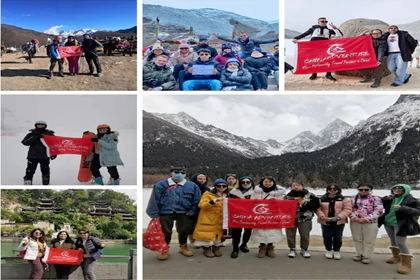

2. Easy booking and Flexible cancellation! Unlike most travel agency, we do provide free cancellation policies to travelers with good reason such as disease, covid, family emergency etc.
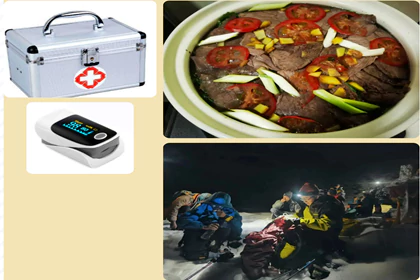
3. Safety guarantee journey and well-equipped logistic support team
For mountain hike trip , we provide
Professional Climbing Equipment and Well-prepared Logistic Support

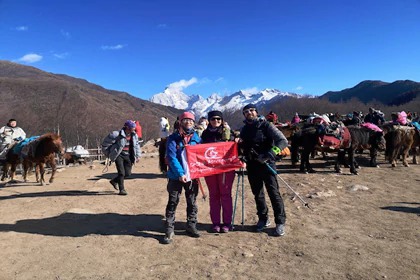
4. We took to you less-tourists visited off the beaten path only to let you know real China
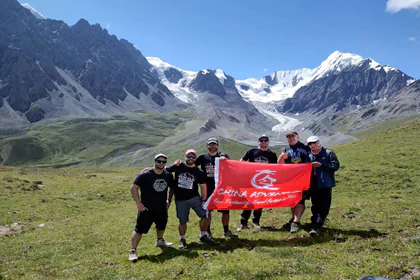
5. Special gifts , free holiday dinner and souvenirs for holidays from China Adventure Team
Reviews
No reviews for this product yet.